
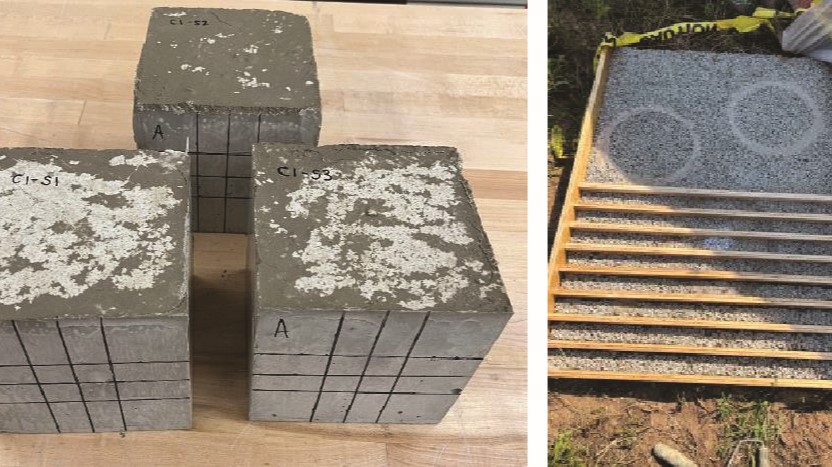
Extending the life span of concrete pavements and bridge decks can save costs and significantly reduce interruptions to traffic. This research focused on enhancing the filler material as well as exploring effective injection methods to save time and reduce traffic disruption. The repair formulations were evaluated based on two main criteria: workability and injection into the crack using appropriate delivery method. Three formulations were selected. Formulation A mixes have Portland cement, Micro fly ash, very fine sand (No.100), and superplasticizer. Formulation B mixes use CTS Cement All and Quikrete Fastset Cement component available in the NJDOT QPL list with added polymer and superplasticizer. Formulation C mixes are GeoPolymer based mixes and include metakaolin, micro fly ash, zirconium sand, iron oxide and superplasticizer. These formulations were tailored for different crack widths and geometries. This research investigated ultrasonic testing (UT) based non-destructive methods for crack characterization and repair evaluation. Laboratory tests were conducted on brick specimens to establish the initial properties of ultrasonic signals. Further tests were conducted on concrete beams after fatigue loading and reinforced concrete slabs with varying crack profiles. An UT methodology was developed that relied on general pristine behavior of concrete rather than point specific pristine profiles. Crack depth evaluation was conducted by comparing time of arrival. The signals from the cracked state were used as the reference and the shifts in time of arrival towards the pristine trend, along with amplitude gain relative to the cracked state, were used to assess repair quality. In addition, the feasibility of automated inspection and repair of potholes are investigated. By integrating high-resolution laser scanning with SLA-based 3D printing, customized patch geometries were successfully generated from artificial pothole models. A low-cost 3D image scanning system was developed for pavement pothole inspection. Laboratory experiments were conducted on artificially created potholes with different depths, areas, and surface roughness levels. Validation through benchmarking against a high-precision laser scanner demonstrated that the system achieves comparable geometric accuracy.
Innovative Pothole Repair Materials and Techniques – Phase 2: Concrete Crack Repair, Ultrasonic Testing, and Automated Repair and Inspection
Status: Completed
Report Number: FHWA NJ-2025-006
Performing Organization: Rutgers University
Principal Investigator(s): Wang, Hao
Project Manager(s): Venkiteela, Giri
Start Date: November 1, 2023
Completion Date: November 1, 2025