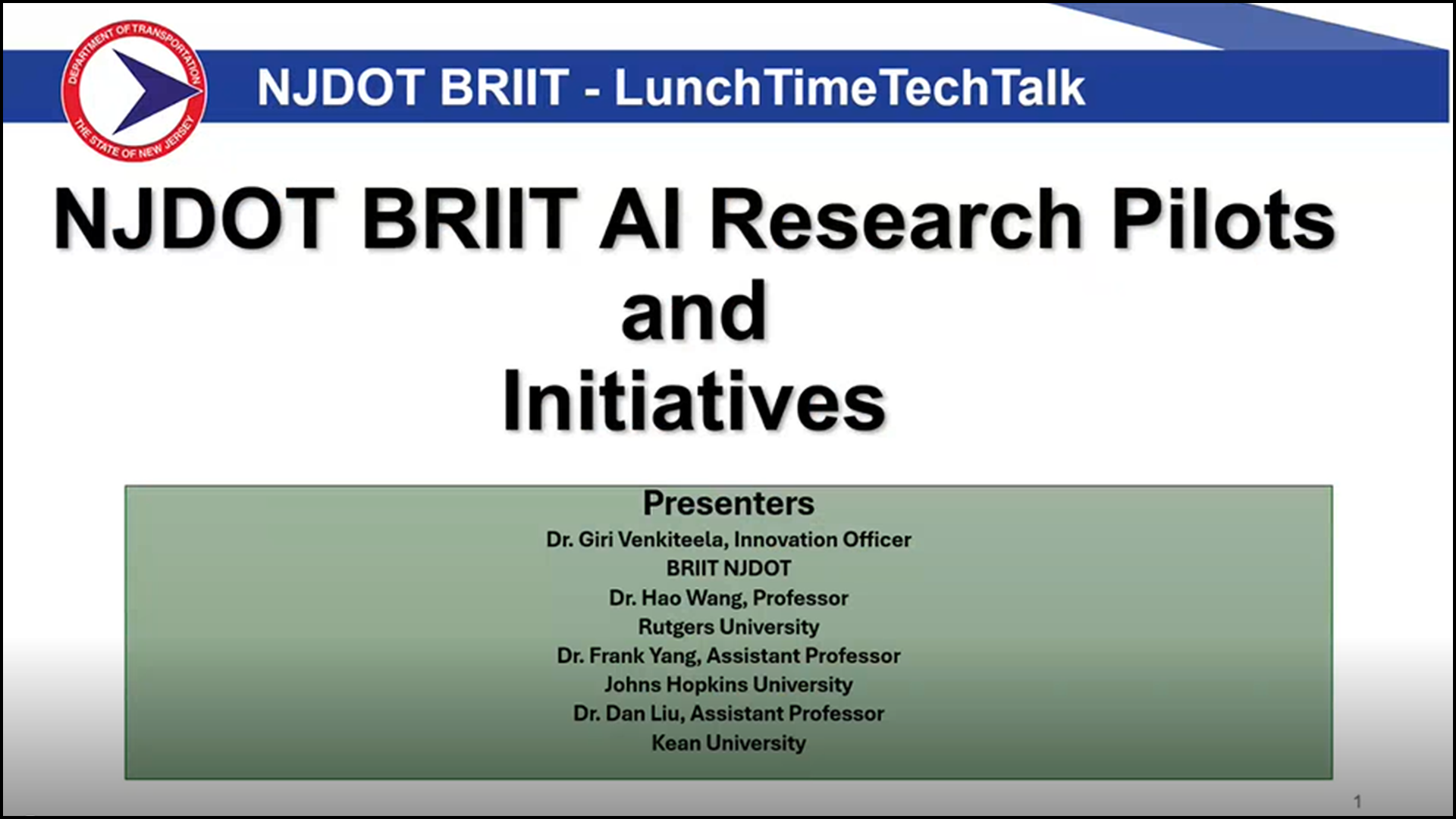
The NJDOT Bureau of Research, Innovation, and Information Transfer (BRIIT) hosted a LunchTime Tech Talk on June 12, 2026, focused on AI research pilots and Initiatives. The webinar introduced the Transportation Pooled Fund Study TPF-5(573) State DOT Council for Strategic AI Adoption, and highlighted several AI use pilot projects initiated by the NJDOT.
BRIIT’s AI Journey and Strategic Role
Dr. Giri Venkiteela, Innovation Officer at NJDOT BRIIT, welcomed participants and introduced the purpose of the Tech Talk. He explained that BRIIT’s role is to help NJDOT understand emerging technologies, build internal literacy, support hands-on exploration, and assist NJDOT units in identifying potential AI use cases.
Dr. Venkiteela outlined the BRIIT’s AI roadmap, which began with early questions about AI capabilities and expanded through research scans, peer exchanges, national conversations, and the creation of an NJDOT AI working group. Starting in 2025, BRIIT launched pilot projects with research partners and NJDOT subject matter experts. In 2026, NJDOT advanced this work by leading a national pooled fund study on strategic AI adoption for state DOTs.
He also emphasized that AI should be viewed as an assistive tool rather than a replacement for human judgment. Successful AI adoption, he noted, begins with identifying the right problem, understanding available data, and determining where AI can meaningfully support staff workflows.
State DOT Council for Strategic AI Adoption
A central focus of the webinar was the NJDOT-led Transportation Pooled Fund Study TPF-5(573), “State DOT Council for Strategic AI Adoption.”
Learn more about the pooled fund study at: https://pooledfund.org/Details/Study/1806
Dr. Venkiteela explained that the study brings together state DOTs to share lessons learned, identify common challenges, exchange use cases, and develop practical strategies for AI deployment in transportation agencies. The study is intended to help participating agencies avoid duplicating efforts, learn from one another, and better understand issues such as data quality, governance, security, ethics, policies, and implementation pathways. Approximately 20 to 22 states expressed interest in participating, reflecting the widespread need for practical guidance on AI adoption.
NJDOT has established a steering committee with representatives from participating state DOTs and is collaborating with FHWA on the pooled fund study. BRIIT also issued an RFP for peer exchange facilitation, which was under review at the time of the presentation. As the pooled fund study progresses, BRIIT plans to involve NJDOT units in discussions relevant to their functional areas.
AI Research Pilots
Dr. Venkiteela introduced BRIIT’s AI pilot efforts, which are intended to evaluate low-risk, practical applications before considering broader implementation. The pilots were developed with NJDOT subject matter experts in construction, materials, and bridge areas, along with university research partners.
The goal of the pilots is to give NJDOT units hands-on experience with AI tools using sample data while helping staff understand both the capabilities and limitations of the technology. The pilot projects also provide an opportunity to evaluation how future AI tools could be integrated into agency workflows in coordination with the NJDOT IT unit.
AI Assistant for Construction and Materials Documents
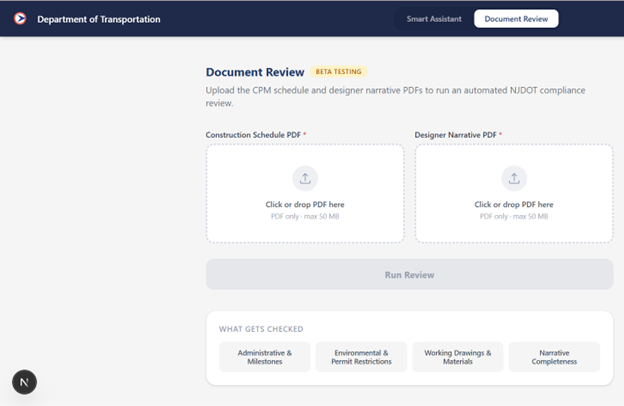
Web interface for AI-Powered Smart Assistant
Dr. Dan Liu, Assistant Professor at Kean University, presented an AI-Powered Smart Assistant designed to support NJDOT staff in navigating construction and materials documents more efficiently. The tool addresses the challenge of locating information within lengthy technical references, including standard specifications, materials procedures, and construction schedule manuals.
The AI assistant allows users to ask questions in plain English and receive answers grounded in official NJDOT public documents. It can also identify relevant Base Document Change (BDC) amendments when the underlying content has been updated.
During the live demonstration, Dr. Liu showed how users can access the tool through a web interface, ask questions about contract requirements or technical definitions, and view source documents alongside the AI-generated response. She also previewed a document review feature that would allow staff to upload construction schedules or narratives and evaluate them against a defined review checklist.
AI-Enabled Bridge Inspection Dashboard
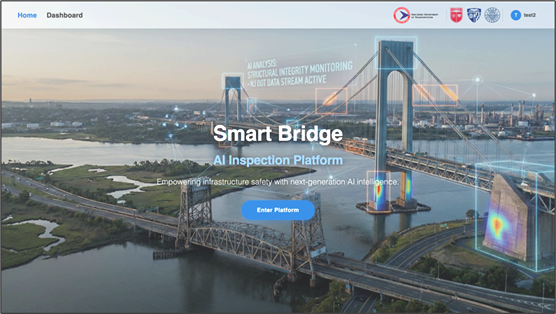
Sign-on for Smart Bridge, AI Inspection Platform
Dr. Frank Yang, Assistant Professor at Johns Hopkins University, presented an AI-Enabled Bridge Inspection Dashboard designed to help users search, summarize, compare, and analyze bridge inspection reports. Dr. Yang described the tool as a “co-pilot” for engineers working with large collections of PDF reports containing narrative text, tables, images, numerical records, and recommendations.
The dashboard includes three primary functions: general question answering, detailed information retrieval, and cross-report analysis. Users can upload bridge inspection reports, ask questions, and receive responses that identify relevant pages, paragraphs, tables, or images. The system uses a mixture-of-experts approach to select appropriate models and a knowledge graph to support document retrieval and reduce hallucination.
During the live demonstration, Dr. Yang showed how the online dashboard can summarize bridge characteristics, compare condition ratings across reports, identify pages containing conclusions and recommendations, and retrieve images showing defects. He noted that human review remains essential, especially for detailed technical decisions.
AI-Enabled Structure Defect Detection Tool
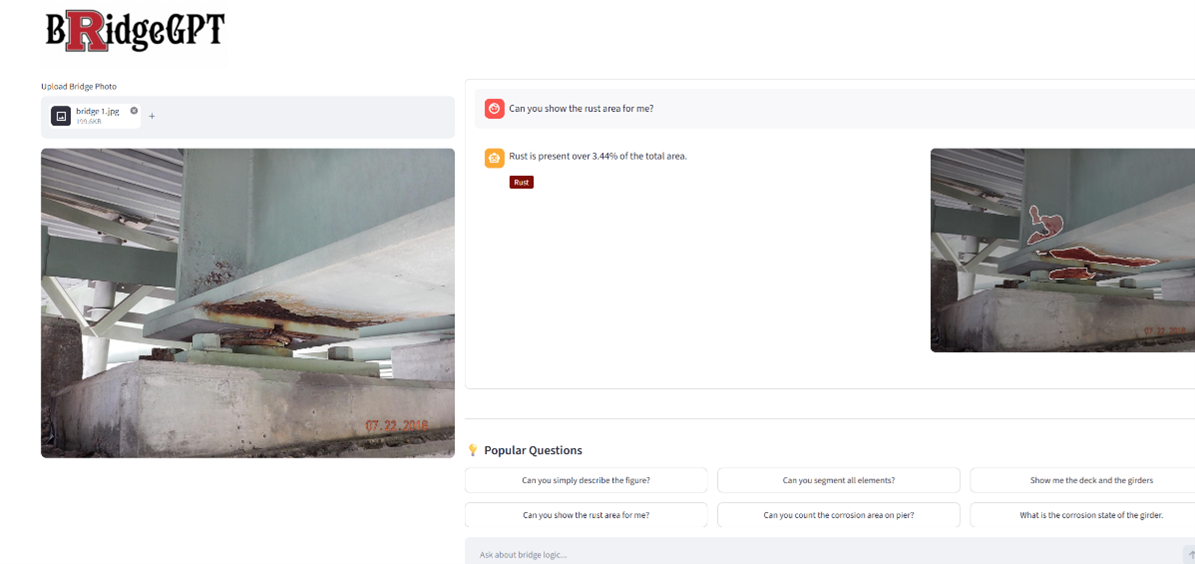
Demonstration of plain language request to identify rust on a bridge girder using the AI-Enabled Structure Defect Detection Tool
Dr. Hao Wang, Professor at Rutgers University, presented an AI-Enabled Structure Defect Detection Tool using steel bridge corrosion as an example. The pilot combines computer vision and large language model capabilities to analyze bridge inspection photographs captured by inspectors or drones.
The tool allows users to upload an image and ask questions about bridge elements and visible defects. It can identify bridge elements such as girders, decks, bearings, bracing, and substructure components; detect corrosion areas; estimate severity; and incorporate domain knowledge from bridge inspection manuals into its analysis.
During the live demonstration, Dr. Wang showed how the tool segments bridge elements, highlights corrosion areas, calculates the affected areas, and provides condition state information based on bridge inspection guidance. He noted that the current pilot focuses on corrosion defects but could be expanded through additional image datasets and model training to detect other bridge defects, such as cracks.
Discussion and Next Steps
The session concluded with questions from participants, including a discussion about how AI tools could eventually interact with NJDOT’s legacy systems. Dr. Venkiteela noted that this is an important issue for NJDOT and other state DOTs and emphasized the need for collaboration among IT staff, data teams, functional units, and peer agencies.
He encouraged participants to continue sharing questions, ideas, and potential AI use cases, as NJDOT continues to advance its AI initiatives.
The Tech Talk demonstrated how carefully scoped pilots can help NJDOT explore AI capabilities, build staff knowledge, and prepare for the responsible, practical adoption of emerging technologies across the agency.