The NJ State Transportation Innovation Council (NJ STIC) met virtually for its second and final Biannual Meeting of 2026 on August 12. The central discussion focused on NJDOT’s plans to advance three innovations from Round 8 of the Every Day Counts program (EDC-8): Beyond Bid-Build: Innovative Project Delivery Methods; Connected Corridors; and UAS: 2.0 Innovative Infrastructure Management. The SME team lead of each initiative presented the current path to implementation. Following the EDC-8 discussion, Nadereh Moini, Chief of Transportation and Transportation Safety at the New Jersey Sports and Exposition Authority (NJSEA), provided an update on the Optimizing an Adaptive System Performance to Improve Travel Time Using ATSPM Module project, which received a STIC Incentive Grant in 2025.
Welcoming Remarks and FHWA Updates
Eric Powers, Assistant Commissioner at NJDOT, delivered the welcoming remarks. He highlighted that innovation is not something that should be done on the side; rather, it should become an institutional habit. Mr. Powers also announced that this would be his final NJ STIC meeting, as he will be retiring in October. He left the NJ STIC attendees with a final message that the group is a shining star for others to follow and encouraged them keep up the good work.
Christopher Paige, Innovation Coordinator and Community Planner at the FHWA New Jersey Division Office, noted that EDC-8 innovations are now officially underway. FHWA will host peer exchanges on these innovations at a date to be determined.
Every Day Counts Round 8
Giri Venkiteela, Innovation Officer for the NJDOT Bureau of Research, Innovation, and Information Transfer (BRIIT), presented the three EDC-8 innovations that NJDOT selected for advancement. He explained that each innovation was chosen based on feedback the previous NJ STIC meeting’s Mentimeter activity and an internal review process. The SME team leads for each innovation then delivered presentations outlining the path for implementation.
Additional information on the EDC-8 Innovations is available on the FHWA website.
A summary of each innovation follows:
Connected Corridors
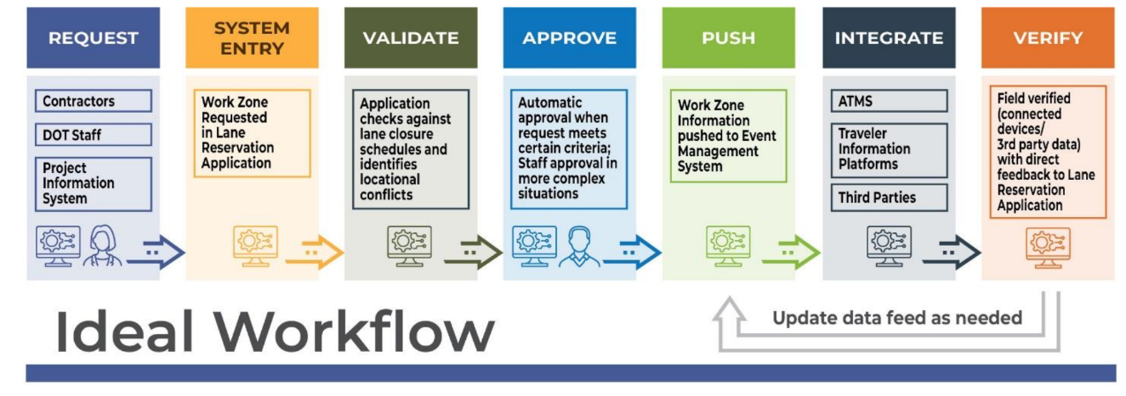
Ideal workflow for the Smart Belt Coalition
Vandana Mathur, Supervisor of Transportation Mobility and Research at NJDOT, presented the implementation plan and potential benefits of the Connected Corridors innovation. NJDOT is a member organization of the Smart Belt Coalition, which includes seven other state transportation agencies and eight research and academic institutions, including Rutgers University. The coalition promotes reliable data sharing and collaboration to improve operational efficiency, increase safety, and support emerging technologies such as Vehicle-to-Everything (V2X), Connected Vehicles (CVs), and Autonomous Vehicles (AVs).
A current problem is the lack of shared standards for data collection and transmission. Because states and local agencies use different standards, data sharing and coordination can be difficult. Through the Connected Corridors innovation, NJDOT plans to collaborate with industry leaders, establish uniform data collection and exchange standards, create compatibility guidelines for AV and CV systems, and test interoperability in real world scenarios.
One planned deliverable is a Smart Belt Coalition website that will house datasets from across the coalition and encourage states and local agencies to publish standardized data feeds. NJDOT also aims to expand data collection through CVs and AVs, maximize existing investment in CVs, and develop clear standards for AVs by creating testing frameworks that ensure readiness for real-world deployment.
The innovation is currently in its early stages, with regular coordination meetings taking place among state members. NJDOT plans to institutionalize the innovation by the end of 2027 through the establishment of the Smart Belt Coalition website.
For more about this FHWA initiative, see the EDC-8 Connected Corridors website.
Beyond Bid-Build: Innovative Project Delivery Methods
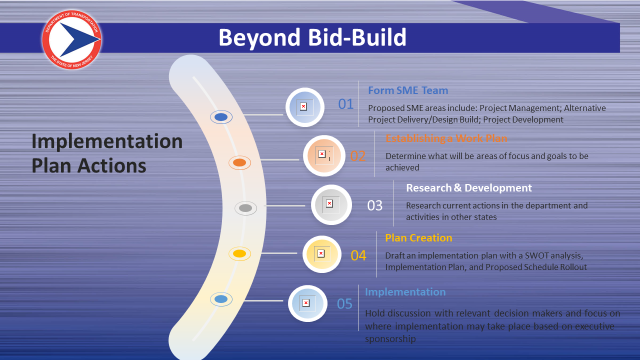
Implementation Plan Actions for Beyond Bid-Build
Scott Ackerman, Manager of Program Management at NJDOT, presented NJDOT’s plans for the Beyond Bid-Build innovation. Currently, NJDOT primarily relies on Design-Bid-Build (DBB) project delivery, in which the agency develops complete plans with a designer, conducts a public bidding process, and awards the contract that provides the greatest value.
While Mr. Ackerman noted that this procurement method has been successful for NJDOT, he emphasized that there are opportunities to increase efficiency, reduce costs, and better manage risks through additional delivery strategies and tools.
Other state DOTs use alternative project delivery methods, including:
- Indefinite Delivery/Indefinite Quantity (ID/IQ): Work is ordered as needed.
- Construction Manager/General Contractor (CM/GC): A contractor is brought into the project earlier to help reduce risk.
- Fixed Price Variable Scope (FPVS): The agency establishes a fixed budget, with quantities adjusted based on bids received.
- Design-Build: A single contract covers both design and construction services.
NJDOT has already begun to advancing its first Design-Build project at the Route 50 Bridge over Cedar Swamp Creek in Upper Township and will evaluate its effectiveness.
NJDOT plans to advance the Beyond Bid-Build innovation through the following steps:
- Forming an SME Team
- Establishing a work plan to define the initiative’s focus and goals
- Researching practices used by other transportation agencies
- Develop an implementation plan that includes a SWOT analysis and proposed rollout schedule
- Implement the selected strategies
UAS 2.0: Innovative Infrastructure Management
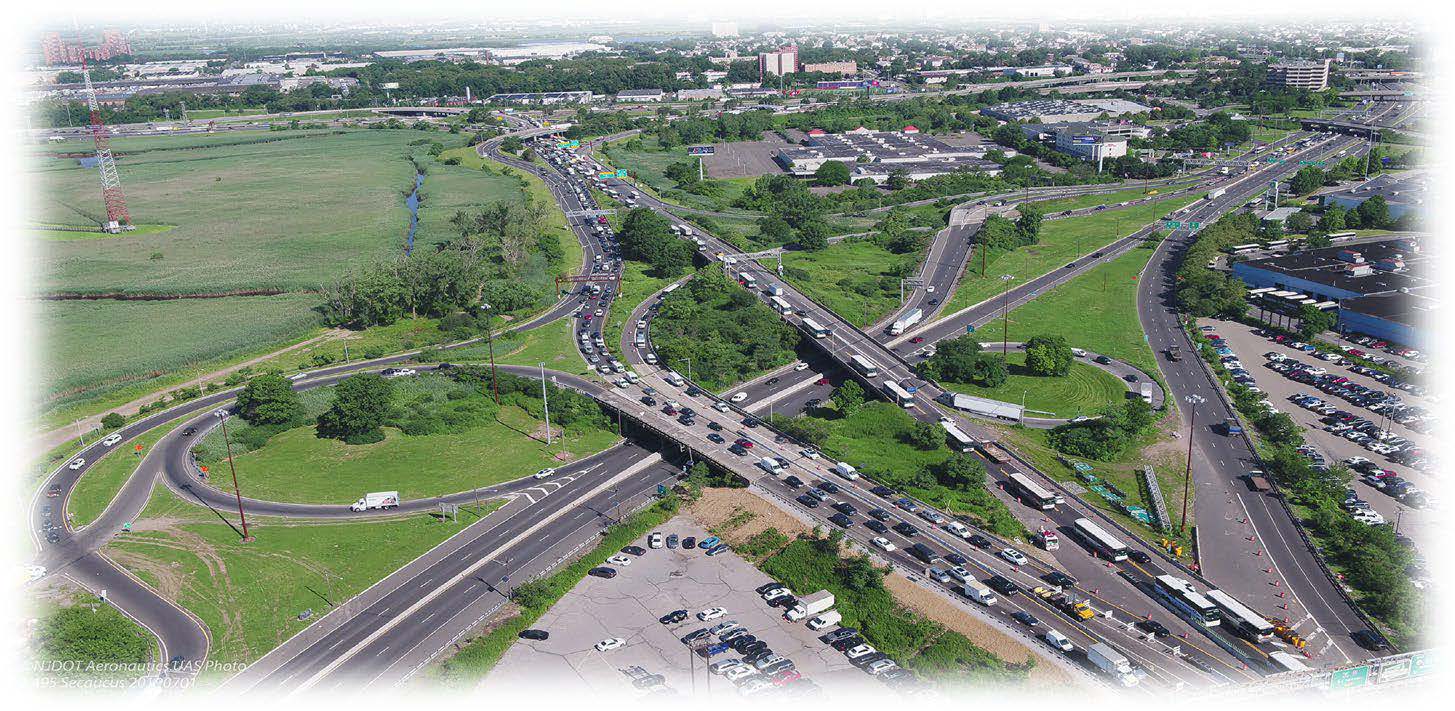
Example of an image that a drone could provide for traffic monitoring
Kimbrali Davis, Manager of the NJDOT Bureau of Aeronautics, presented on NJDOT’s existing use of drones and the improvements planned under the UAS 2.0: Innovative Infrastructure Management initiative.
NJDOT established its Unmanned Aircraft System (UAS) Program in 2016 and fully institutionalized the technology during the EDC-5 UAS initiative. Today, the program supports project monitoring, structural evaluation, geotechnical engineering, emergency response, traffic pattern monitoring, and National Transportation Safety Board (NTSB) investigations.
For example, the UAS program helped a NTSB investigation of a PATCO fatality during COVID. The resulting work was later incorporated into a nationwide FTA training document.
During Phase 2 of the UAS initiative, NJDOT aims to increase accuracy, accelerate data collection, and further reduce employee risk and agency costs. The UAS Program will advance these goals in four areas.
Infrastructure Construction Project Management
NJDOT will institutionalize standards for collecting drone imagery before, during, and after project delivery, to support consistent monitoring and evaluation of project progress.
UAS Fleet Management
NJDOT will implement a new fleet management system to provide operational, financial, and compliance benefits. The agency plans to improve routine maintenance and continuously track assets and performance metrics such as battery cycles, sensor conditions, flight hours, and downtime.
Dock-Based Operations

Docking station for a drone
NJDOT will begin utilizing docking stations, often referred to as “drone-in-a-box” systems, that provide automated housing, charging, and launch infrastructure. These systems enable remote and autonomous drone operations, minimize the need for human intervention, reduce costs, improve response times, and enable continuous coverage.
In addition, NJDOT plans to pioneer a mobile docking system by integrating docking stations into NJDOT trucks, allowing rapid deployment, dynamic coverage, and on-demand missions.
Data Collection Systems
NJDOT plans to expand data collection capabilities through the use of multiple sensor types, including:
- Optical/RGB Cameras
- Multispectral Sensors
- LiDAR, Infrared Imaging
- GPS Receivers
- Inertial Measurement Units (IMUs)
These technologies will support work such as terrain modeling, thermal analysis, and geotagging. NJDOT also plans to enhance its data warehousing infrastructure to accommodate increased volume of collected data.
For more about this FHWA initiative, see the EDC-8 UAS 2.0 website.
Optimizing an Adaptive System Performance to Improve Travel Time Using ATSPM Module: STIC Incentive Update
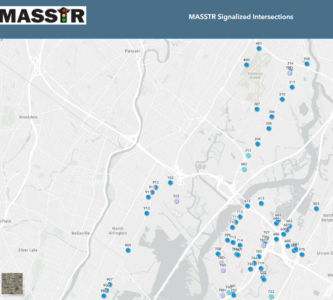
Signalized intersections in the MASSTR Network
Nadereh Moini of NJSEA provided an update on the Optimizing an Adaptive System Performance to Improve Travel Time Using ATSPM Module project, which received a STIC Incentive Grant in 2025.
NJSEA is the regional and planning zoning agency responsible for a 30.3-square-mile district in the Hackensack Meadowlands that spans 14 municipalities in Bergen and Hudson counties. In 2010, NJSEA received a $10 million Tiger II grant from USDOT to install 123 signalized intersections into the Meadowlands Adaptive Signal System for Traffic Reduction (MASSTR) network.
The MASSTR network adjusts signal timings based on real-time traffic flows to reduce congestion, delays, and travel times. However, the system requires ongoing fine-tuning and currently relies on community complaints to identify areas requiring adjustment. NJSEA lacks sufficient resources to proactively assess, analyze, and optimize system performance on a continuous basis.
Through the STIC innovation grant project, NJSEA will optimize the MASSTR network using the Arterial Management Center (AMC) platform, also known as the Automated Traffic Signal Performance Measure (ATSPM) system, developed by AtkinsRéalis and Rutgers researchers for NJDOT.
NJSEA is piloting the platform along two corridors. The first corridor is near Teterboro Airport and includes a variety of land uses and transportation modes. The second corridor was selected by NJDOT and served as a primary access corridor to the Meadowlands Spor ts Complex during the FIFA World Cup matches.
To date, the project team has completed the design and planning phases and integrated corridor intersections into MASSTR network. Next steps include:
- Installing the ATSPM/AMC module
- Creating a dashboard for corridor assessment
- Evaluating and optimizing MASSTR operational parameters
- Publishing a final project report
Announcements and Reminders
Build a Better Mousetrap
Submissions for the New Jersey Build a Better Mousetrap competition are due August 31. For more information, click here.
2026 Research Showcase
NJDOT will host its 28th annual Research Showcase on Wednesday, October 28. The theme for this year’s event is The Road Ahead: AI and the Future of Transportation.
BRIIT AI Workshop (for NJDOT Staff)
BRIIT will host an AI Workshop on Monday, October 26 at the NJDOT Bordentown Training Facility. Further information will be provided at a later date.
TFP-5 (573) State DOT Council for Strategic AI Adoption
NJDOT serves as the lead agency for the Transportation Pooled Fund study on strategic AI adoption, which includes 17 state DOT partners from across the nation. NJDOT will host the study’s first peer exchange in November 2026.
Next Meeting
The next NJ STIC meeting will take place in January 2027.
A recording of the NJ STIC 2026 2nd Biannual Meeting is available here, along with the day’s presentations below.
BRIIT Slides
Optimizing an Adaptive System Performance to Improve Travel Time Using ATSPM Module: STIC Incentive Update
Beyond Bid-Build: Innovative Project Delivery Methods
Connected Corridors
UAS 2.0: Innovative Infrastructure Management